LexValet: A Lightweight Website for a Full-Service Law Firm
The web presence for a full-service law firm advising across India. Cloud Technopix built and manages a deliberately simple, fast site that presents seven practice areas clearly and meets the profession's disclaimer expectations.
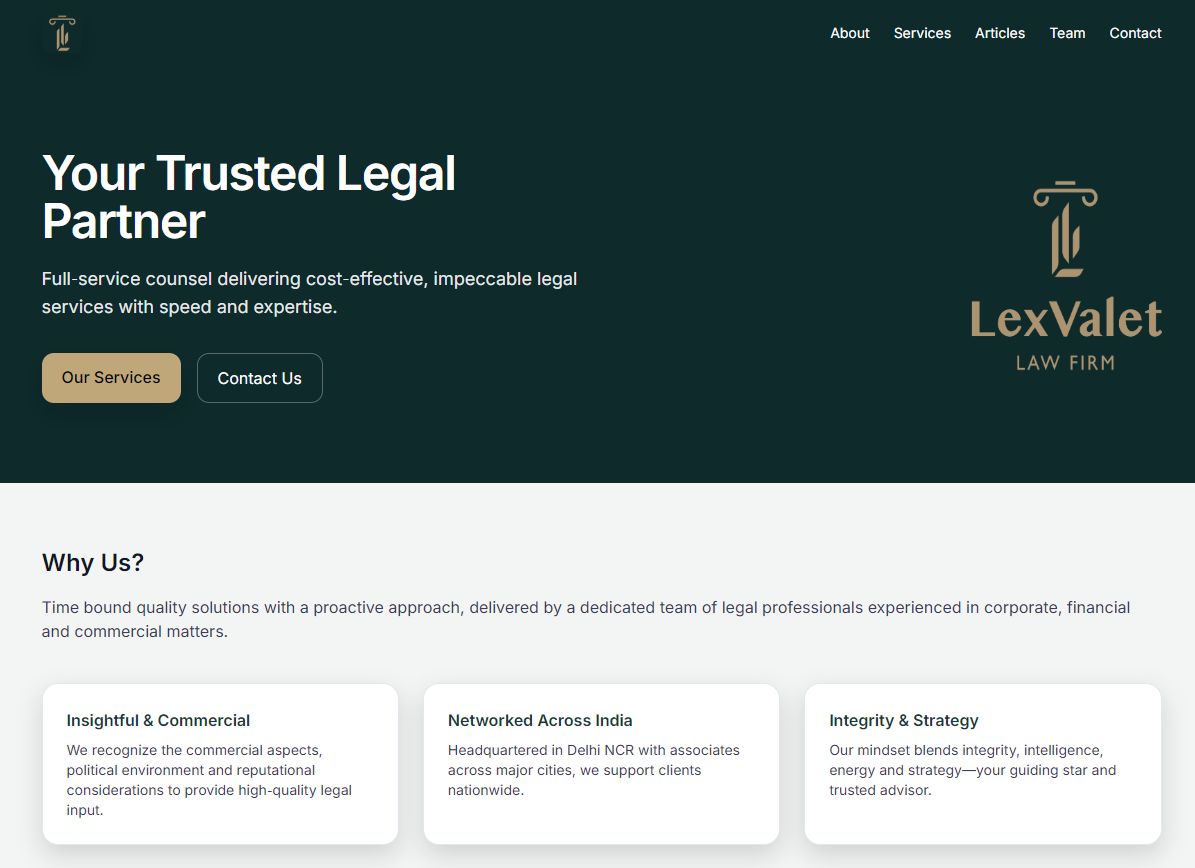
Visit LexValet. Built and managed by Cloud Technopix. This page describes the public site only; no client details beyond what the firm publishes.
The problem
A full-service firm covers a wide range of matters: intellectual property, labour and employment, POSH compliance, consumer protection, cyber law and due diligence, plus civil and criminal litigation. Its website has to convey that breadth while staying simple enough for a visitor to find the right service in seconds.
Law firms in India also operate under professional rules on advertising and solicitation. A site that reads like marketing, or that fails to state clearly what it is, creates its own risk for the firm.
Our solution
We chose simplicity on purpose. LexValet is a lightweight static site: plain pages, a small number of images, no moving parts that can break. Static pages are fast on slow connections, inexpensive to host, easy to keep secure and simple for the next person to maintain. For a firm whose value is in its advice, not its interface, that is the right trade.
The structure is a handful of clear pages: home, about, services, team, articles, contact, and privacy and terms pages. The home page introduces the firm and lists key practice areas, with a short statement of why clients choose it. The services page describes each practice area, including the courts and forums the firm appears before, from the Supreme Court and High Courts to tribunals and consumer commissions.
How we worked
We worked directly with the firm's lead to turn their practice into plain, accurate page copy and a navigable structure, then built, reviewed and launched the site. The firm owns the legal substance; we own structure, presentation, hosting and upkeep. After launch we handle updates and fixes as the firm adds articles or changes its team and services.
- Practice areas and wording agreed with the firm before build.
- A disclaimer step on first visit, consistent with Bar Council of India expectations for law-firm websites.
- Review of every page by the firm before publication.
- Ongoing maintenance as content changes.
What the site does
- Presents seven practice areas: IPR and trademarks, labour and compliance, POSH, consumer protection, legal due diligence, cyber law and technical support to NGOs.
- Lists the courts, tribunals and forums the firm appears before.
- Offers articles on practical topics such as POSH compliance and trademark basics for startups.
- Provides contact details and an enquiry form.
- States clearly that the site is informational and not advertising, solicitation or legal advice.
End-to-end engineering
Static architecture
Pages are pre-built HTML served directly, with relative links and a shared asset folder. There is no database or server-side code to patch, which removes most of the attack surface that dynamic sites carry and keeps hosting costs minimal. Pages load fast because there is little to load.
Compliance and trust
We built the disclaimer acceptance step and the privacy and terms pages into the site from the beginning, because a law-firm website should be clear about its status. The same attention to the details of a regulated profession applies to the legal-tech work we do for other firms.
Accessibility and mobile
The layout is responsive and text-led, so it reads well on phones, where many first visits happen, and it works for assistive technology. Images carry alternative text, and there is no content hidden behind scripts.
Operations
We manage hosting, certificates and deployments, and ship content updates on request. Keeping the architecture simple is what makes that low-risk and inexpensive for the firm.
What this shows about how we build
Not every project needs a complex stack. LexValet shows that we choose the simplest architecture that does the job, a principle laid out on our technology page, and then look after it. For sites that need more structure and scale, see the WhiteOwlLegal case study and our web development service.