PeshaMitra: Jobs That Are Actually Hiring
A job-matching platform built around honesty: every listing shows whether the employer still replies, and silent jobs get marked rather than boosted. Designed, built and operated by Cloud Technopix.
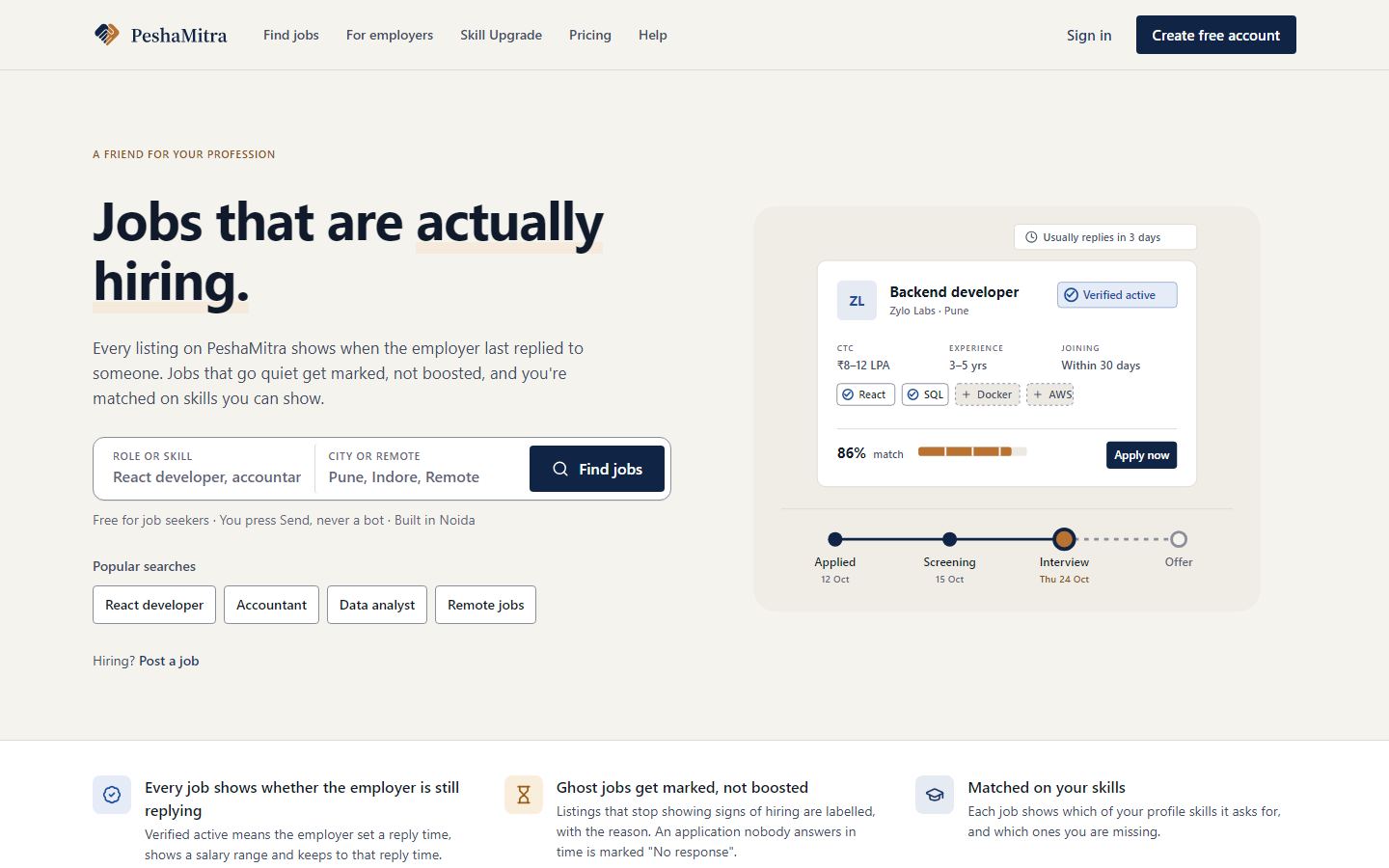
Visit PeshaMitra. Free for job seekers. Built in Noida by Cloud Technopix.
The problem
Job boards earn from listing volume, so listings stay up long after anyone is hiring. Candidates apply into silence, never learn whether a role is still open and cannot tell a live opening from a ghost job. Cover letters get rewritten from scratch each time, and skills listed on a resume are claims nobody can check.
Employers have the mirror-image problem: floods of poorly matched applications and no cheap way to show candidates that they do respond.
Our solution
We designed PeshaMitra around behaviour instead of volume. Employers promise a reply window when they post a job. The platform watches what actually happens to applications, and the job's seal follows the behaviour, not the payment. A listing earns Verified active when the employer sets a reply time, shows a salary range and keeps to the reply time. When a listing stays silent, its seal changes to Going quiet, with the reason shown.
Candidates see where every application stands as a running status trail, with the date the employer promised to reply by. An application nobody answers in time is marked No response. The result is an honest signal at the point of decision, before anyone spends an evening on an application.
How we worked
PeshaMitra is a product we run, so we worked with both sides of the market in mind: job seekers and employers. We prototyped the seal logic and status trail first, because they are the heart of the product, then built search, applications, profiles and the employer pipeline around them. Delivery follows our standard loop: weekly releases to staging, short demos and a backlog re-ordered by feedback. The site publishes a help centre, a public status page and API documentation, which are part of how we operate it.
What the product does
For job seekers
- Search by role or skill and city or remote, with each job showing which of your profile skills it asks for and which you are missing.
- A running status for every application and a promised reply date.
- AI-written drafts of cover notes, recruiter emails and LinkedIn messages built from your own profile and career log. Parts taken from your profile are highlighted so you can check them, nothing goes out until you change it or approve it, and there is no auto-apply.
- ATS-friendly resumes in five templates with PDF download.
- Verified skills from certificates and test results linked from providers such as HackerRank, Coursera, LinkedIn and Udemy.
- Skill Upgrade: pick a target role, compare it with your verified skills and get a learning path of short topics, with hours for each.
- Referral jobs where a batchmate, ex-colleague or community member has offered to refer.
For employers
A pipeline view with applicants in lanes, candidates ranked on verified skills, and the reply-time promise that earns the Verified active seal.
End-to-end engineering
A state machine for trust
The seal is a computed state, not a label. It depends on the employer's promised reply window, the observed time to first response, the share of applications answered on time and how long a listing has been silent. Modelling it as an explicit state machine, with transitions that are recorded and explained to users, keeps the signal credible and auditable.
AI grounded in the user's own data
Drafting uses the candidate's profile and career log as the source, and marks which parts came from it. That design choice, which keeps a human in the loop and prevents invented experience, is the same discipline we apply to AI agents and RAG systems for clients. Free users get five drafts a month for each tool, so cost is bounded.
Skills, matching and referrals
Matching compares a job's required skills with a profile's verified skills and surfaces the gap, which feeds directly into the learning-path feature. Referral matching connects people who offer to refer with people who ask, and routes a request to a person who has already said yes.
Operating a two-sided marketplace
The platform has job seeker and employer sign-up, pricing, a help centre, careers, a public status page, API documentation and the legal pages that go with a marketplace: privacy notice, terms, cookies and refund policy. We run it: releases, monitoring, moderation tooling and support.
What this shows about how we build
PeshaMitra pairs a transparent rules engine with AI that stays inside guardrails, inside a marketplace with two kinds of users. It draws on the same skills as our SaaS and web development work, and the interface follows the principles on our UI/UX page.